CONVERSATIONS WITH THE PEOPLE WHO MOVE THE INDUSTRY
INTERVIEW OF THE MONTH
Ricardo Pinto
Biomethane starts in the field
THE OPENING CONVERSATION
From the field to the market
Renan Lopes · 2026-11-02
Biomethane growth in Brazil depends on more than adding production capacity. It depends on projects that can integrate feedstock availability, industrial operation, the agricultural use of nutrients and year-round energy supply.
In the sugar-energy sector, that integration starts in the field. Vinasse and filter cake already play important roles in sugarcane cultivation. By adding biodigestion, a mill opens a new opportunity to generate energy, but it also needs to assess how the digestate will be managed and what value will return to the agricultural operation.
That is the starting point for the first edition of Insights, AVENTRA's newsletter. In our interview with Ricardo Pinto, we discuss the decisions that connect biomethane production to soil fertility and agricultural efficiency.
The market is moving too. Petrobras's call for biomethane and certificates, along with the debate on natural gas decarbonization targets, opens new prospects for producers and buyers. At the same time, the evolution of diesel prices and transport costs underscores the importance of assessing energy prices across the entire supply chain.
Insights was created to follow these developments and to offer analysis that supports long-term decisions. Each edition will bring together the views of industry professionals, market topics and relevant data for the development of biomethane in Brazil.
Enjoy the read.
Renan Lopes
CEO and Founder | AVENTRA
THE CENTRAL QUESTION
How do we integrate energy, soil fertility and agricultural efficiency?
THREE THEMES FROM THE INTERVIEW
01
FEEDSTOCKS
Filter cake: energy and agricultural value.
Characterization, preparation and assessment of the complete system, from receiving the material to returning the nutrients to the field.
02
DIGESTATE
Nutrients with a defined destination and management.
Nutrient balance, fraction separation and responsible agronomic use.
03
RESULTS
How do we measure the gain in the field?
Logistics, effective fertilizer substitution and evidence across harvests.
Full interview
Biomethane starts in the field
From filter cake to digestate: how to integrate energy, soil fertility and agricultural efficiency
Interview with Ricardo Pinto
Biomethane production opens an opportunity for the sugar-energy sector: tapping the energy potential of sugarcane co-products and returning nutrients to the crop. To turn that opportunity into results, the project needs to connect industrial operations with agricultural planning.
1. When we talk about biomethane, the discussion usually centers on energy. Why look at the field as well?
Because a significant share of the result depends on what happens before and after the biodigester. Before, we need to organize the availability, quality and logistics of the feedstocks. After, we need an efficient agronomic destination for the digestate, the name we give to the end product of biodigestion besides biogas.
At a mill, this integration is especially interesting: vinasse and filter cake are already part of the agricultural operation. Biomethane production adds an energy-recovery step, but it must preserve the logic of nutrient recycling. I would assess the project by its combined result: energy produced, logistics cost and the value actually recovered in the field by replacing part of the mineral fertilization with digestate.
2. What role does filter cake play in this integration?
Filter cake has agricultural value of its own, linked to the organic matter and nutrients it carries, phosphorus in particular. So bringing it into a biomethane project has to take its existing use in the field into account.
The question is how much additional value we can obtain by running this material through biodigestion and returning the digestate to the field. That assessment should compare the complete system with direct application or composting, considering energy, processing, transport and agronomic performance. The best alternative may vary from mill to mill.
3. What precautions are needed to use filter cake for biogas and biomethane production?
The first is to know the actual material that arrives at the biodigestion plant. Moisture, solids content, impurities and the characteristics of the organic matter affect both receiving and biodigestion.
Storage, preparation, mixing and reactor feeding also need to be assessed. Part of the material degrades more slowly, and that must be considered in sizing and in biodegradability tests. Consistent operation depends on representative characterization and testing, as well as good integration with the mill's routine.
4. What is digestate, and what is its value for agriculture?
Digestate is the material that remains after anaerobic digestion. During the process, part of the organic matter is converted into biogas, while the remaining material keeps its potential for agricultural use.
Its value depends on its composition, the availability of its nutrients and the application conditions. That is why I would treat digestate as an input that needs to be known and managed. Laboratory analysis, soil assessment and agronomic recommendations are what turn that potential into a benefit for the crop.
5. Can digestate replace the mineral fertilizers used in sugarcane fields?
It can replace a portion, but there is no universal percentage. Substitution depends on the amount of nutrients actually supplied, their availability to plants, the timing of application and the needs of each area.
We also need to avoid a common mistake: calculating the dose to meet one nutrient and ending up over-applying another. The way forward is to incorporate digestate into the crop's nutrient balance and supplement whatever is missing. Savings should be measured by the mineral fertilizer we can safely replace from an agronomic standpoint, while maintaining productivity and soil quality.
6. Does it make sense to separate digestate into a solid fraction and a liquid fraction?
It can make a lot of sense when the separation solves a logistics problem or enables a more suitable agricultural use. The two fractions then have different handling, composition and application characteristics.
However, separation does not remove nutrients, nor does it guarantee a concentrated product on its own. We need to measure how nutrients are distributed between the fractions and assess the cost of equipment, energy and downstream steps. The decision should start from the intended destination: which areas will be served, at what distance and with which equipment.
7. Can digestate be turned into higher-value products, such as organomineral fertilizers?
Yes, there are processing and enrichment routes that can broaden the possibilities for its use. But the product needs to be developed from a defined agronomic need and a defined market.
That requires consistent composition, quality control and logistics viability. It is also important to distinguish a material with fertilizer potential from a standardized commercial product. Adding value means delivering a solution that growers can store, apply and evaluate with confidence. The processing cost has to fit into that equation.
8. What are the main risks in storing and applying digestate?
I would highlight nutrient losses, unbalanced application and, in rare cases, risks of water contamination when management is entirely inadequate. Storage and field distribution must be designed with the same rigor applied to gas production.
That includes storage capacity compatible with the agricultural calendar, calibrated equipment, assessment of soil conditions and monitoring of the material's quality. Biodigestion does not do away with these precautions. The environmental benefit depends on the whole chain working well, including after the digestate leaves the reactor.
9. How can you show that this integration delivers results for the mill and for the grower?
We need to track energy, agricultural and economic indicators. In the field, I would look at agricultural yield, the evolution of soil fertility, application cost and the effective substitution of mineral fertilizers. At the industrial plant, biogas yield, operational stability and processing costs.
It is also essential to compare areas using consistent criteria, taking into account soil, sugarcane variety, climate and management history. A good one-off result is a positive sign, but expansion decisions need evidence across harvests. The goal is to demonstrate a recurring gain per hectare and for the operation as a whole.
10. What is your main recommendation for anyone structuring a biomethane project in the sugar-energy sector?
Bring the agricultural team to the negotiating and planning table from the start. Feedstock availability, the location of the areas, the application calendar and existing infrastructure directly shape the project's design and viability.
The destination of the digestate must be resolved in planning, with the same attention given to the destination of the biomethane. When we connect energy production and nutrient management, we create the conditions to capture more value from sugarcane and its co-products. That integration is what can turn a new industrial facility into a lasting improvement to the production system.
One interview a month. Perspectives from those who decide, operate, finance and study the industry.
ON THE RADAR
The context behind the conversation.
Two analyses on energy, markets and biomethane.
MARKETS AND LOGISTICS
Ocean freight and diesel margins strengthen biomethane's competitiveness
AVENTRA · 2026-10-30
Diesel price formation requires looking beyond the price of crude oil. The spread between the product and crude, ocean freight, the exchange rate and landing costs determine the replacement cost of imported fuel. For biomethane produced from sugar-energy residues, this context reinforces the economic value of a regional supply.
Logistics returns to the center of the analysis
In an analysis dated October 21, the International Energy Agency (IEA) reports that freight for large crude tankers between the Gulf and Asia exceeded US$ 37 per barrel in mid-month. Diversions and delays reduce fleet productivity, and the pressure also reaches product shipping. These figures describe specific routes and should not be applied directly to Brazilian imports.
Brent, crack spread and freight: distinct components
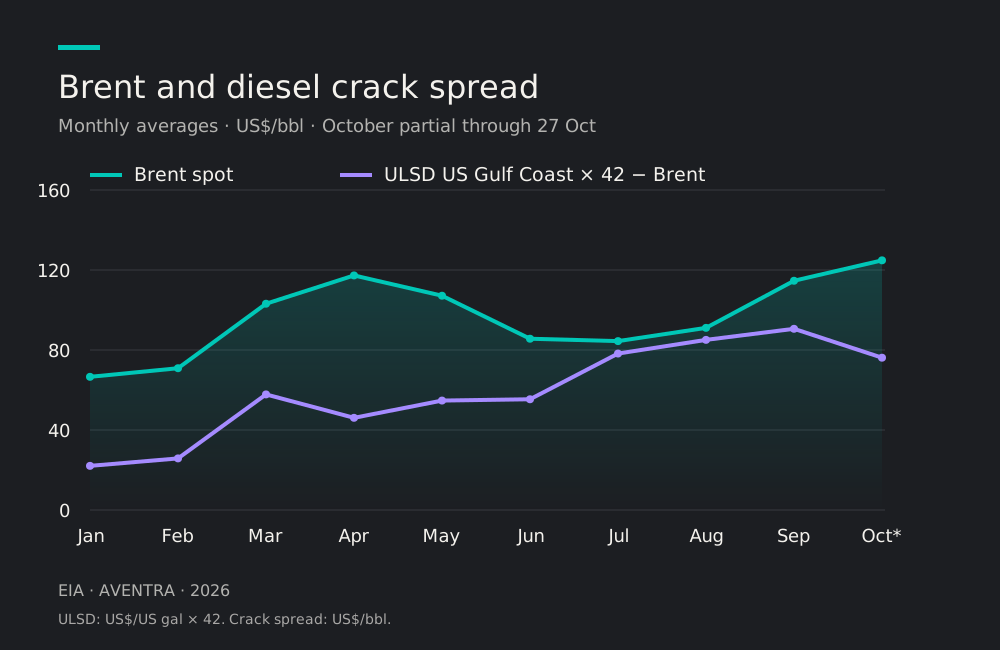
The diesel crack spread is the difference between the price of the product and a crude oil benchmark, expressed in the same unit. It is a gross market indicator, not a refinery's net margin. To track it, AVENTRA uses ultra-low sulfur diesel (ULSD) on the US Gulf Coast and Brent spot, both published by the EIA.
Averages for matching dates show Brent at US$ 66.59/bbl in January and US$ 124.83/bbl in October, through the 27th. Over the same period, the crack spread rose from US$ 22.07/bbl to US$ 76.15/bbl. The spread averaged US$ 90.60/bbl in September. October is a partial month.
Freight for delivery to Brazil is an additional component of import parity. Although market prices reflect logistics and supply constraints, the crack spread is not a measure of that freight. Adding it again to the international diesel price would double-count the product spread.
Energy comparison and parity scenario
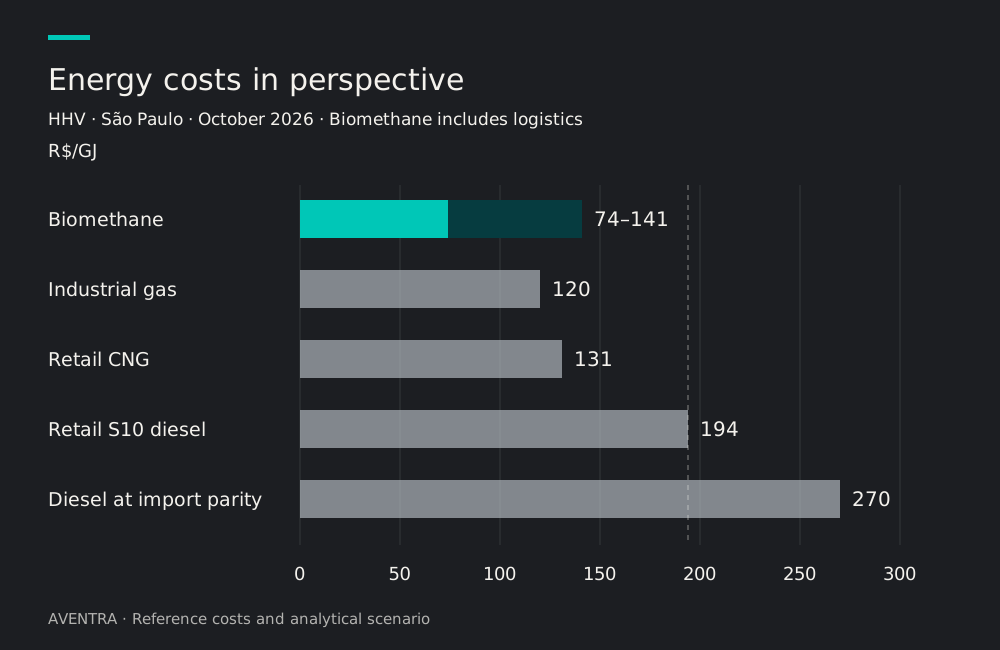
In the simulation presented by AVENTRA for São Paulo, S10 diesel at R$ 7.32/L is equivalent to approximately R$ 194/GJ. The parity scenario of R$ 10.21/L corresponds to about R$ 270/GJ. This is an analytical pump-price assumption, not a forecast of a price adjustment or an official parity quote.
The R$ 2.80–5.30/m³ reference range for biomethane, including logistics, corresponds to approximately R$ 74–141/GJ under the higher heating value (HHV) assumptions adopted. That represents an energy cost 27% to 62% lower than diesel at R$ 7.32/L. The range brings together study references with different substrates; it is not an AVENTRA commercial offer, nor a proven cost for every vinasse and filter cake plant.
At the bottom of the range, biomethane is also below the benchmarks for industrial natural gas (R$ 120/GJ; R$ 4.70/m³ for consumption of 100 thousand m³/month) and CNG at the pump (R$ 131/GJ; R$ 5.17/m³). At the top of the range, that advantage over both fuels does not hold. These are benchmarks from AVENTRA's comparison for São Paulo, subject to supply conditions.
The difference of approximately R$ 76/GJ between diesel at the pump and the parity scenario is, on its own, equivalent to the cost of biomethane at the bottom of the range.
For vehicle use, the analysis must factor in efficiency and total cost of ownership. In a sensitivity case with 18% higher energy consumption for the gas vehicle, the range rises to approximately R$ 87–166/GJ equivalent to the service provided by diesel. The percentage is a comparison assumption; performance depends on the engine, the route and the operation.
Implications for mills and heavy transport
Regional biomethane reduces direct exposure to the maritime logistics of fuel. Its costs remain subject to substrate productivity, plant availability, electricity, compression, delivery distance and financing.
Long-term contracts can turn this structure into supply predictability. The choice of index is decisive: contracts linked to diesel at a discount retain exposure to its price; formulas based on costs and domestic indices offer a different risk profile. The assessment should integrate price, availability, quality and fleet performance.
Methodology and sources
Comparison on an HHV basis; values rounded. Brazilian prices and the parity assumption are premises of the analysis provided by AVENTRA, with October 2026 as reference. The comparison does not, on its own, demonstrate savings in total cost of ownership.
Chart: monthly averages of matching daily observations, from January to October 27, 2026. Crack spread = ULSD spot US Gulf Coast (US$/US gallon) × 42 − Brent spot (US$/bbl). October partial. AVENTRA calculation based on the EIA dataset used in the Radar, consolidated on 10/28/2026. Chart data (CSV).
Biomethane target: 2027 may have headroom; 2028 requires expansion.
AVENTRA · 2026-11-02
On October 30, Petrobras opened a call for proposals to purchase biomethane, with supply starting in 2027 and contracts of up to ten years. The fuel may replace part of the natural gas consumed at refineries and other industrial facilities. The company is also accepting offers of Biomethane Guarantee of Origin Certificates (CGOB), under contracts of up to two years, renewable for an equal period. Proposals are non-binding and may include projects under development.
Registration on the Petronect Portal and requests to participate are open until December 11. Proposals will be received from December 14 to 22, until 8 p.m. The difference between the terms allowed for gas and for certificates signals the importance of distinguishing long-term physical contracting from the purchase of the environmental attribute. Final terms depend on commercial negotiation.
The target and the timeline
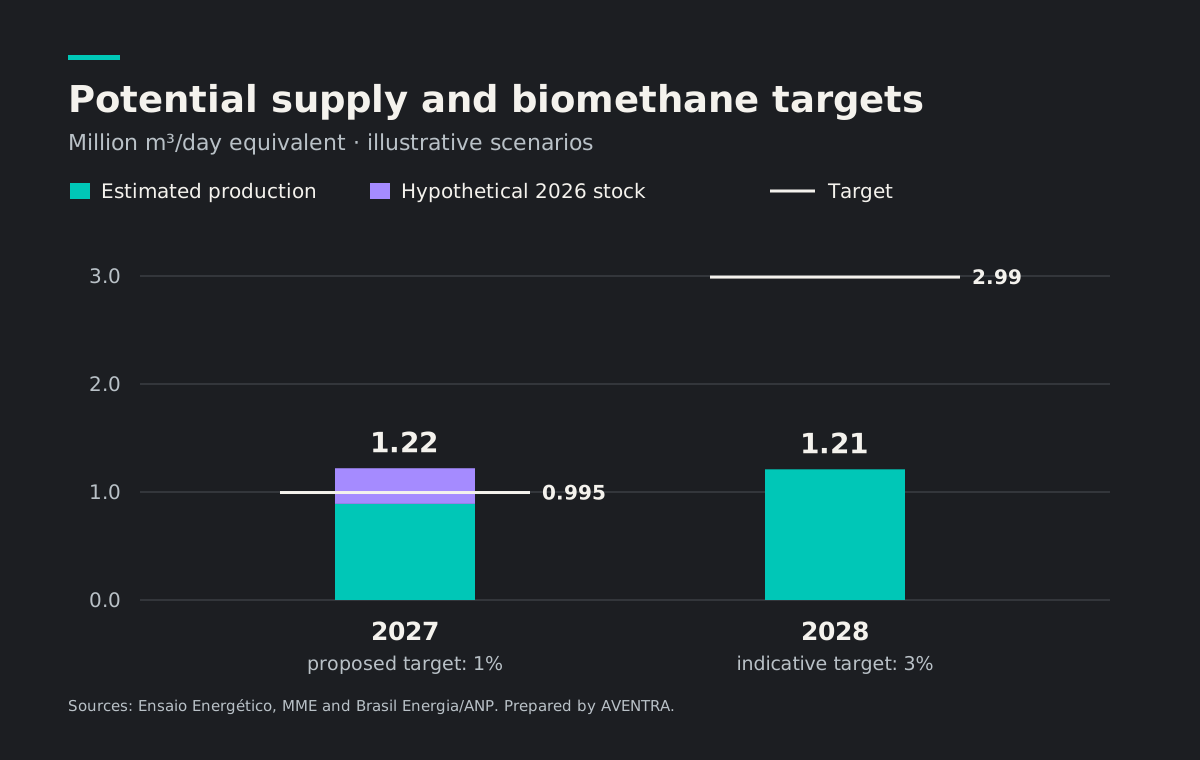
The natural gas market decarbonization program began with an emissions-reduction target of 0.5% in 2026, equivalent to 504.8 thousand m³/day of biomethane in the reference simulation. In October, the Ministry of Mines and Energy (MME) put forward for public consultation a proposed 1% target for 2027, corresponding to 995.2 thousand m³/day, or 3,632,492 CGOBs for the year. The consultation also sets out an indicative path of 3% in 2028, 4% in 2029 and 5% in 2030, equivalent, in the reference estimates, to 2.99, 3.98 and 4.98 million m³/day.
The 2027 proposal depends on a decision by the National Energy Policy Council (CNPE). The percentages for 2028 to 2030 are indicative and subject to annual review. According to Petrobras, preliminary individual targets for 2027 are expected in December, with final consolidation in March 2027.
2027: the stock may create headroom
A study by Edmar de Almeida, Felipe Freitas and Gustavo Soares, published in Ensaio Energético in September, estimated the potential supply of certificates for 2027. The analysis considers the capacity of units eligible for the certification process, which requires at least four months of authorization, and different plant utilization levels.
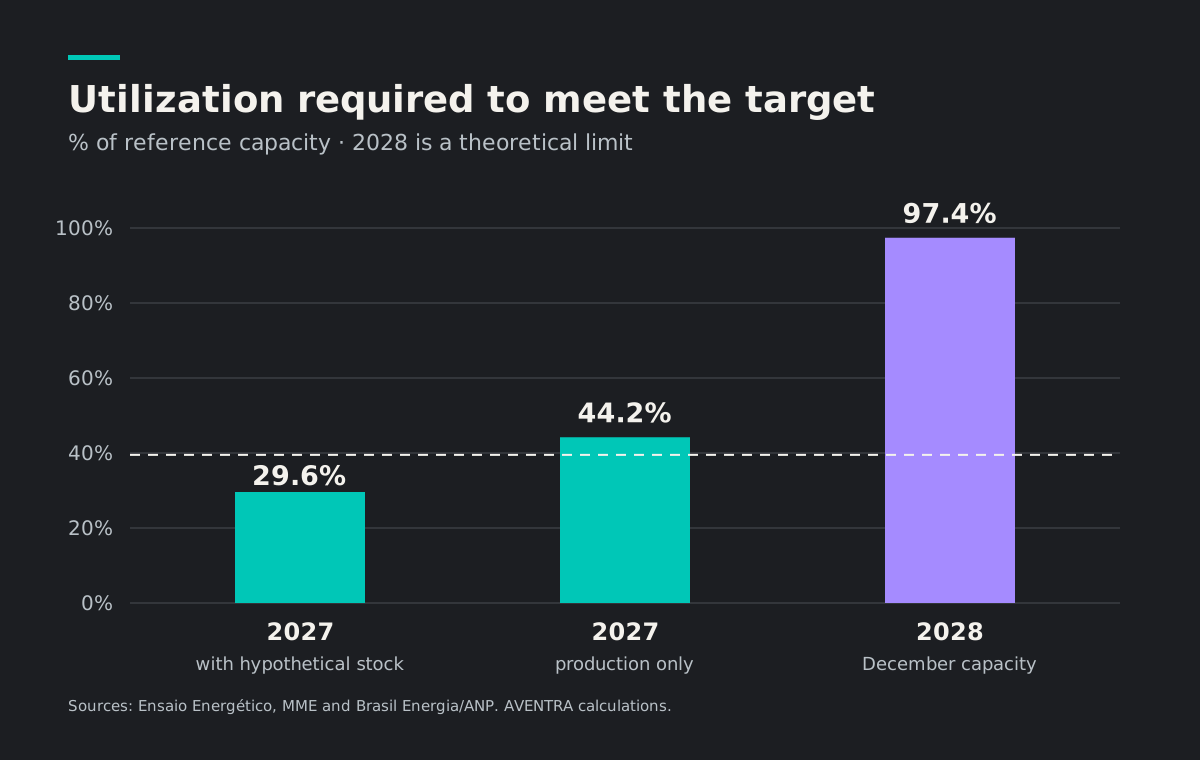
In the 39.5% utilization scenario observed between January and July 2026, potential 2027 production would be approximately 325 million m³, below the 363.2 million m³ in the MME proposal. With the eligible annual capacity estimated in the study and the MME volumetric target, the utilization required from that year's production alone would be approximately 44.2%.
A possible 2026 stock changes the math. The study estimated a surplus of about 120 million m³ equivalent in the hypothetical scenario in which the first CGOB was issued on October 1, 2026. Whether that stock actually forms depends on the issuance date, certification and eligible production. Under that assumption, added to 2027 production at 39.5% utilization, the available volume would reach about 445 million m³ equivalent, or 22.5% above the MME's proposed benchmark. The required utilization would fall to about 29.6%, provided the entire estimated stock were available to meet the target.
2027 supply: estimates from the study published in Ensaio Energético, with a hypothetical first CGOB on October 1; the target uses the MME's later benchmark. For 2028, an illustrative AVENTRA scenario: capacity projected for December by Brasil Energia × 39.5% utilization, without estimating stocks. Values are equivalent daily averages, not a monthly production forecast.
The original study compared its scenarios with an earlier benchmark of 358.7 million m³ for the 1% target. That is why it shows 43.6% utilization without stock and 29% with stock. The percentages above were recalculated by AVENTRA using the later 363.2 million m³ benchmark published by the MME, keeping the study's other assumptions.
2028: capacity does not keep pace with the target
A Brasil Energia survey based on ANP data indicates that, if the projects under construction are completed on schedule, installed capacity could reach 3.07 million m³/day by the end of 2028. The indicative 3% target is equivalent to approximately 2.99 million m³/day. To match that volume from production alone, the industry would need to operate at 97.4% of the capacity projected for December throughout the entire year — a supply-friendly assumption, since units completed during the year will not be available from January.
Prepared by AVENTRA based on the study published in Ensaio Energético, the MME proposal and the Brasil Energia/ANP survey. For 2027, factors were recalculated with the MME volumetric benchmark. For 2028, 2.99 ÷ 3.07 is a theoretical limit: it uses December capacity for the whole year and does not estimate certificate stocks.
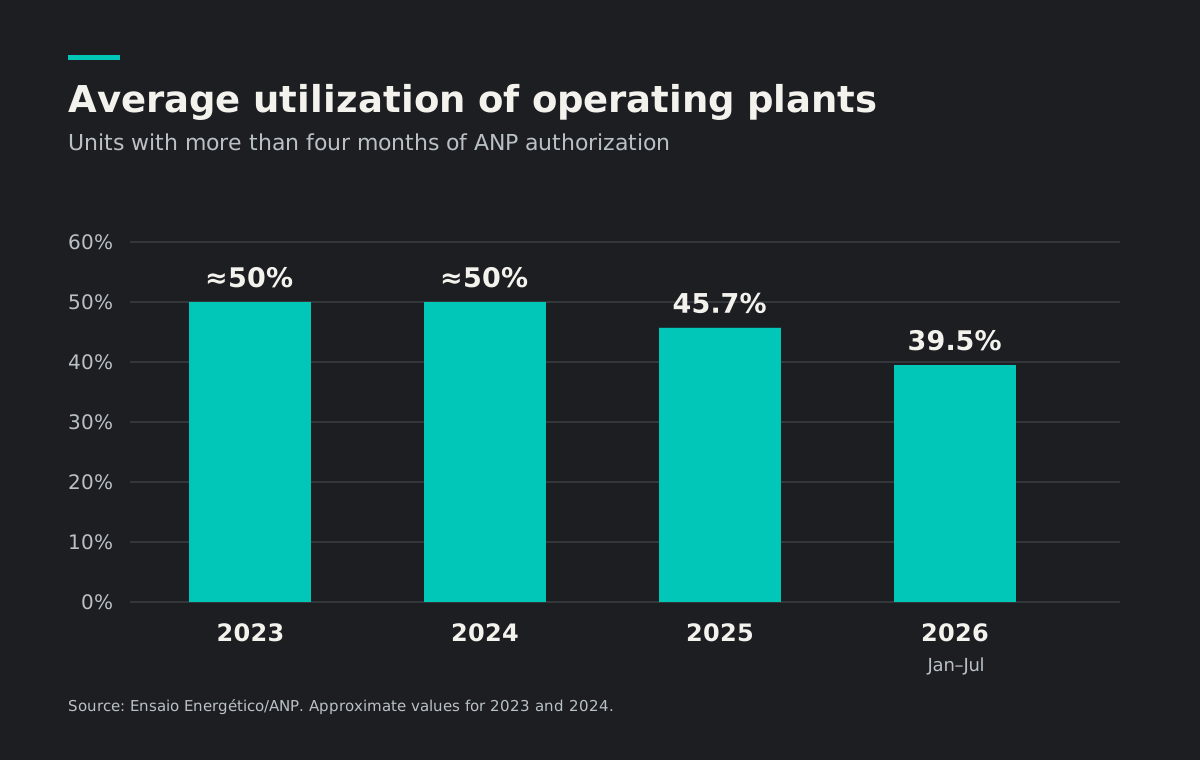
The historical average utilization of units with more than four months of ANP authorization was close to 50% in 2023 and 2024, fell to 45.7% in 2025 and reached 39.5% between January and July 2026. The study notes that units still ramping up may pull the average down, but also considers its future evolution uncertain.
Source: study published in Ensaio Energético, with ANP data. Values for 2023 and 2024 are approximate.
Applying 39.5% to the capacity projected for December 2028 yields theoretical annualized production of about 1.21 million m³/day, approximately 1.78 million m³/day below the indicative benchmark. The comparison is illustrative: it is not a forecast of a certificate shortfall, as it does not estimate the stock available in 2028 or the capacity actually certified. CGOBs issued at the end of 2026 may remain valid for part of the first half of 2028; any contribution depends on issuance dates, prior use and the applicable rules.
Implications for mills
The sugar-energy sector has vinasse and filter cake at scale, concentrated at the industrial unit, and can occupy a significant part of this space. The investment decision, however, must account for permitting, construction, commissioning and certification. The issuance of the first certificates will depend on each project's schedule and conditions; an entry after 2028 should also be assessed against the indicative 4% target for 2029.
Long-term contracts may require delivery throughout the year. At the mill, that depends on the off-season strategy, including filter cake storage or the use of other co-substrates, and on the plant's actual performance. In AVENTRA's view, a surplus of certificates could put pressure on the spot price in 2027, while the expansion of targets could strengthen demand in the following years. This is a scenario, subject to regulatory definition, certified supply and market behavior. Long-term physical contracts can reduce exposure to the certificate spot market, depending on their commercial terms.
Calendar
December 11, 2026: deadline for registration and requests to participate in the Petrobras call.
December 14 to 22, 2026: proposals received on Petronect, until 8 p.m. on the last day.
December 2026: preliminary individual targets for 2027 expected to be released.
March 2027: individual targets expected to be consolidated.
Pending confirmation: CNPE decision on the 2027 national target.
US Gulf Coast ULSD spot × 42 − Brent spot, on matching dates. Monthly averages. Side value: latest daily observation. International gross spread. Source: EIA; AVENTRA calculation. Source: EIA · AVENTRA calculation
Diesel B S10 · average pump price
2026-10-18 — 2026-10-24 · ANP Average retail price by state, ANP weekly survey. The sample varies by state and week. Source: ANP
CNG · average pump price
2026-10-18 — 2026-10-24 · ANP Average retail price by state, ANP weekly survey. The sample varies by state and week. Source: ANP
Figures are fixed for this edition. Each source has its own observation date.
AVENTRA
Smart infrastructure for renewable molecules.
AVENTRA develops biomethane infrastructure projects for the Brazilian sugar and ethanol industry, integrating technology, financing, construction and long-term operation. We are structuring our first unit.